
Last updated: July 21, 2026
I will be honest, before writing this blog I had never heard of oat milk. One Saturday morning I hopped in the car with my 6 year old daughter and 3 year old son seeking to find this new beverage. After bringing it home, we taste tested original flavor and chocolate flavored oat milk. To my surprise, my children liked both… and so did I!
Milk Alternatives
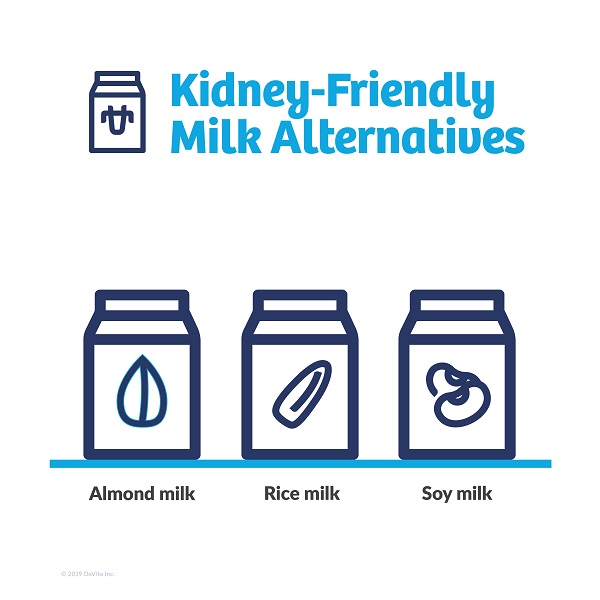
There are several plant-based milk alternatives available. Some of the ones lower in minerals include almond milk, rice milk and soy milk. We are seeing even more products on the milk shelf, including cashew milk, peanut milk, hemp milk, coconut milk and now, oat milk. Each type of milk alternative and each product must be evaluated before including in a kidney diet.
What’s in Oat Milk
This simple beverage contains 2 main ingredients: oats & water. It may also contain oat bran, sugar cane, cocoa powder and 2% or less phosphate & calcium additives, vitamins A, B2, B12 & D2. Manufacturers of the oat milks I reviewed include Oat-ly, Silk, & Pacific Foods.
People with chronic kidney disease (CKD) may need to limit minerals such as sodium, potassium, phosphorus or calcium in their diet. Here is a breakdown of these minerals in oat milk.
8 fluid ounces of Oat Milk contains:
- Potassium 133 – 390 mg
- Calcium 121 – 350 mg
- Phosphorus 120 – 270 mg
- Sodium 100 – 150 mg
In comparison, 8 ounces of 1% fat milk contains 366 mg potassium, 305 mg calcium, 232 mg phosphorus and 107 mg sodium.
As you can see from the above values some brands of oat milk have much more potassium, phosphorus or calcium than other brands due to additives. These additives are generally absorbed by our bodies ~100%. Where these nutrients naturally occur in milk are generally absorbed 40-60%. Avoiding additives and consuming natural forms of potassium and phosphorus are a better choice. Ask your dietitian for guidance before adding oat milk to your meal plan. For many people oat milk may enjoyed in moderation (8 oz or less/ day) and be part of a kidney-friendly diet, if you find those with less additives or no additives.
How to Make your Own
You can make your own kidney-friendly oat milk with a handful of ingredients.
- 1 cup of rolled oats
- 4 cups of water
- 1 pinch of salt (optional)
- 1 whole date (pitted) or 1 tablespoon maple syrup
- 1/2 teaspoon vanilla extract (optional) or 2 T cocoa powder (optional)
- 1/4 c berries (optional)
Place these ingredients in a blender at high speed for 1 minute. Use a very thin towel or cheesecloth to drain out oat milk and discard oat remnants. Store in a closed container in the refrigerator for 2 to 3 days.
More Information on Oats
For more information on oats and whole grains in a kidney diet read “ Food Facts Friday: Oats and Oatmeal ”, “ Ancient Grains in Today’s Kidney Diet ” and “ Including Whole Grains in a Kidney Diet ”.
Reference:
http://www. minimalistbaker.com accessed March 30, 2019
Picard K. Potassium Additives and Bioavailability: Are We Missing Something in Hyperkalemia Management? J Ren Nutr. 2019 Jul;29(4):350-353. https://pubmed.ncbi.nlm.nih.gov/30579674/. Accessed July 21, 2026.
Cupisti A, Kalantar-Zadeh K. Management of natural and added dietary phosphorus burden in kidney disease. Semin Nephrol. 2013 Mar;33(2):180-90. https://pubmed.ncbi.nlm.nih.gov/23465504/. Accessed July 21, 2026.